Midwest Adventures #3
AMES, Iowa — I’m still in recovery.
I arrived home around midnight on May 1. I was very tired, worn out from my three-day trip to the annual Los Angeles Times Festival of Books. But when I got into the condo and dropped my things, I decided for some reason that it was time to take out the kitchen trash. I tied up the bag and walked to the dumpster, which is only about 40 feet from my front door. As I reached for the dumpster’s lid, I had a sensation — one of those sensations that novelists always have trouble describing, a feeling that something isn’t quite right, that what I’m doing might not work out exactly the way I expect.
Indeed. As I lifted the lid to throw in the bag, there was a noise, the frantic scrabbling of a beast within. I was startled — okay, I freaked out briefly. I let go of the lid and leaped backward with a shout as what turned out to be a raccoon scooted through the space between the dumpster and the descending lid. All would have been fine except that in my haste to back away from the animal, I tripped and fell awkwardly to the blacktop.
I tore up my left elbow, as well as the palm of my right hand. I also bruised my hip. Nothing serious, but the row of scabs on and around my elbow is a hindrance to getting dressed and such.
My wife thinks this is pretty funny. “Watch out for Ricky Raccoon!” she’s said several times since. My younger daughter thinks I’m a wuss for being afraid of a little raccoon. She’s right and wrong, of course. She’s right that there’s no reason to be afraid of a raccoon. He’s more afraid of me than I of him. But she’s wrong in the sense that I didn’t know what was in that dumpster. Having moved to the Midwest just a couple of weeks before, I wasn’t familiar with the notion of wildlife of this sort rooting around near your house. It’s very unlikely that anything other than a sad human will be found in an apartment dumpster in Las Vegas. Plus, it was past midnight, dark, and cold, and I was tired as hell.
Anyway, I’ve been leery of that dumpster ever since. I’ve opened it trepidatiously probably five times since then, and no raccoon has jumped out. It probably won’t happen again, but that experience will come to mind every time for a while.
Keeping with the animal theme, let’s talk about the armadillo. You read that right. Armadillos are commonplace in the South, but it’s unusual for them to make an appearance this far north. But it happened this week in the small town of Cambridge, about 15 miles south of Ames.
According to a story in today’s Ames Tribune, a man named Wade Kahler noticed some sort of roadkill on the shoulder of his driveway. He called a city maintenance employee, Dale Hennick, who came out and discovered it was a dead armadillo. He tossed it in the back of his pickup.
Apparently, the Iowa Department of Natural Resources receives “a couple of armadillo reports a year . . . but they are always roadkills.” It’s not clear how the armored creatures get to Iowa, but I would speculate that they somehow end up here by catching a ride on some sort of vehicle, kind of like roof rats in Las Vegas. Otherwise, it’s an awfully long walk.
For the record, it’s illegal to transport an armadillo into Iowa. I don’t know why. (I wonder if Nevada has a similar law.)
Here’s the kicker, from the final two sentences of the article:
“Hennick has no idea what he will do with the curious carcass. ‘I guess I’ll just put him in the refrigerator for now,’ he said.”
Wait: Why does Hennick think the thing to do is to put this dead animal in a refrigerator? Why would he do that? When you don’t know what to do with a dead animal, your plan is to put it in a refrigerator? That would only make sense if he . . . he . . . planned to cook the thing and eat it!
Surely that’s not what he intends to do. Surely.
I wrote a little thing about a writer
Go here for a piece I wrote on the Las Vegas Review of Books website about the British writer Geoff Dyer.
A report on the 2011 Los Angeles Times Festival of Books

The acquisitions.
The annual pilgrimage to the Los Angeles Times Festival of Books featured a little twist this year. The usual routine has been for Steve, Scott and I to pile into a car in Las Vegas on Friday morning and drive to L.A., munching snacks and stopping at a Chili’s along the way. This year I was in Ames, Iowa, so I flew to L.A., and Steve and Scott picked me up at the airport.
From there, things got back to normal. We ate, scoured various bookstores and enjoyed the booths and panels at the festival. Another change this year: Instead of being held at UCLA, the festival was on the USC campus. All things considered, UCLA is a better venue for this event, but USC is all right.
I ended up acquiring quite a few books this year. Nothing unusual about that, but I’m particularly pleased with some of them. A few highlights:
– The Speech: A Historic Filibuster on Corporate Greed and the Decline of Our Middle Class by Sen. Bernie Sanders. Nation Books had a cool idea here. It’s amazing that on Dec. 10, 2010, the Vermont senator spoke continuously for eight and a half hours on the Senate floor, criticizing President Obama’s compromise with the Republicans on tax cuts as part of a wide-ranging discussion of how the rich are getting richer and the poor poorer.
– Engineers of the Soul: The Grandiose Propaganda of Stalin’s Russia by Frank Westerman. Scott and I heard Westerman, a Dutchman, talk on a panel, and his thoughtful comments prompted both of us to buy this book. It’s brand new, and when Westerman signed my book, he said it was the first copy of the U.S. edition that he had signed. The book is about how the Soviets hired writers to basically rename everything to conform to the communist version of history and life, and to write eloquently about mundane things such as a dam on a river. It sounds really interesting.
– The Professor: A Sentimental Education by Terry Castle. This is an essay collection by a Stanford professor that got rave reviews last year but was impossible to find in the chain bookstores. Didn’t have any problem finding it at Vroman’s in Pasadena, of course.
– What?: Are These the 20 Most Important Questions in Human History — or Is This a Game of 20 Questions by Mark Kurlansky. This is a small tome that promises to be a very interesting essay about life’s big questions.
– Out of Sheer Rage: Wrestling with D.H. Lawrence by Geoff Dyer. Dyer, a Londoner, is one of my new favorite writers, and this is probably his most celebrated book. He set out to write a serious study of the great English writer D.H. Lawrence. But this book isn’t what he originally intended to write. Instead, it’s a memoir of sorts about his inability to write a serious study of Lawrence. Dyer was on the panel with Frank Westerman.
– Pinochet and Me: A Chilean Anti-Memoir by Marc Cooper. Cooper, a well-known journalist, is a friend, and Scott, Steve and I spent several hours with him at dinner Saturday night. He’s a journalism professor at USC these days, so he gave us a tour of the Annenberg school, and then we hung out in a semi-secret bar and grill on the campus. Anyway, this is Cooper’s memoir of the period in the early ’70s when he worked as a translator for Chilean President Salvador Allende when he was overthrown by Augusto Pinochet.
– A Heartbreak and a Guitar: Johnny Cash and the Making of Bitter Tears by Antonino D’Ambrosio. This is the story behind Cash’s protest album called “Bitter Tears: Ballads of the American Indian,” which faced censorship and a backlash from country radio stations. This is an enticing piece of cultural history.
– Zeroville by Steve Erickson. I picked this up in a great used bookstore, Book Alley, in Pasadena. Erickson is an interesting writer and this novel promises to be a good entry point to become more acquainted with his work.
Among the panels and talks, the highlight for me was Vincent Bugliosi. He’s a lawyer and best-selling writer whose most famous book is “Helter Skelter” about the Manson family. His new book, which I intend to get but haven’t yet, is called Divinity of Doubt, and it’s an investigative piece attacking both the Christian faith and atheism. Bugliosi is an agnostic, and he explains why in his usual careful, detailed way. He outlines all the inconsistencies in the Bible, and exposes the fact that some common Christian beliefs aren’t even in the good book at all. But Bugliosi is also critical of atheists, who, he says, fail just as badly as believers to make a persuasive case for their cause. “God should only be a question,” he said. Fascinating talk.
I had to leave the book festival a little early on Sunday to fly back to Ames. I caught at taxi about 2 p.m. and soon embarked on the long flight home, my new books in tow. It was late when we landed in Des Moines. As the wheels touched down, I of course turned on my BlackBerry to find out if I had missed anything. It just so happened that I had missed something big: the breaking news that Osama bin Laden had been killed. I had at least three e-mail alerts about it, which I shared with a few people sitting around me on the plane.
I wonder if some big news event will break while I’m at the Los Angeles Times Festival of Books next year?
Today’s Ames Tribune cover
 I thought the Trib staff did a nice job on this issue.
Interview with the writer Vu Tran

Vu Tran
I conducted a long interview with the writer Vu Tran last summer in Las Vegas. He is now teaching creative writing at the University of Chicago. Click here to check it out on the Las Vegas Review of Books website.
A Louis Sullivan design in Algona, Iowa
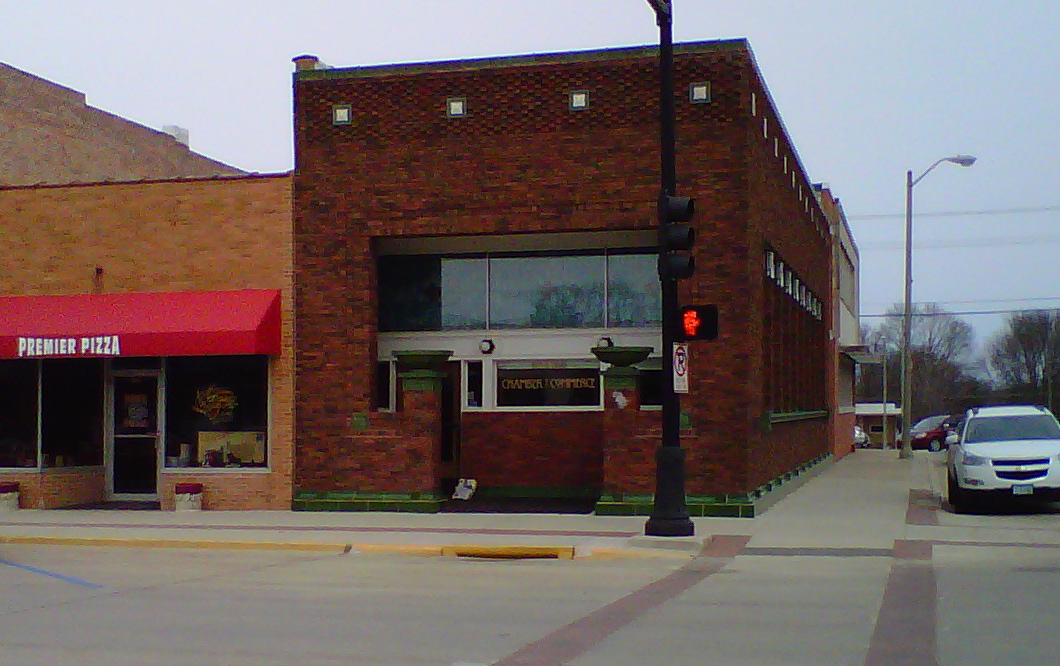
Louis Sullivan building in Algona, Iowa.
The famed skyscraper architect Louis Sullivan designed this building in Algona, Iowa. It is known as the Henry Adams Building, or the Land and Loan Office Building. It was designed in 1912 and opened in 1913.
Although it was never a bank, this building is considered to be one of Sullivan’s “Jewel Boxes,” a series of banks built in the Midwest between 1909 and 1919. There are at least two others in Iowa. This building has many windows, drawing natural light into the workplace.
The Algona Chamber of Commerce occupies the building today. When I visited Algona last week, I didn’t get a chance to go inside, but I’ve been promised such a visit in the future. I’m told the interior is very cool.
Sullivan, a mentor to Frank Lloyd Wright, is the guy who coined the phrase “form follows function.”
Midwest Adventures #2
I’ve been in Ames for two weeks now. Although I miss my family terribly, I enjoy living here. Iowa is interesting. It’s not chaotically interesting like Las Vegas, or exotically interesting like some other locales, but I’ve enjoyed learning about the history of certain places and institutions, and about the economic, political and social happenings and trends in this part of the country.
The presidential race is heating up, and Iowa is ground zero at this early stage. The Republican wannabes are showing up for events and hiring people to run their Iowa operations. The Des Moines Register is doing a good job of keeping track of their comings and goings. I’ve been talking with our editor at the Ames Tribune, and I think I’m going to write some columns over the next 18 months or so dissecting the presidential candidates. The Ames Tribune will cover the candidates who come through Ames, of course, but we don’t have the manpower to cover the campaign on a regular or statewide basis. My task will be to offer a, you guessed it, voice of reason, separating the nutjob candidates from those who live within this little realm we like to call reality. Should be fun.
You might have heard that some tornadoes rolled through Iowa last weekend. There were between 10 and 27 of them, depending on how they’re counted. One particularly nasty one destroyed a good portion of a small town called Mapleton, which is about 125 miles west of Ames, and also did some havoc in a small town called Early. (On that day, we didn’t have any notable weather at all in Ames.) Nobody was killed in Mapleton, and the worst injury was a broken leg. Register columnist Kyle Munson summarized the effect on the town: “The tornado decimated Mapleton’s west side but spared most of the homes in the eastern half. Mother Nature remains fickle down to a matter of city blocks.” The tornadoes also caused some damage in other towns and areas north and east of Mapleton. Our company owns the newspaper in Algona, and our publisher there told me a tornado was sighted about three miles outside of town. The tornado sirens sounded for hours in Algona, I guess, which tends to prevent people from getting a good night’s sleep.
Here are other some random items I’ve picked up from my travels and reading:
– The Amish have a pretty healthy population in Iowa (seventh highest among the states). Not in the Ames area, though. They mostly live in southern and eastern Iowa. Only one Iowa county saw an increase in population in the 2010 Census, and it was one (Davis) with a large Amish population. The Amish are, as you might imagine, a rustic lot, with their horses and buggies, and machinery operated without electricity, but they’re an economic engine in places like Davis County. But not from farming. Register writer Mike Kilen writes: “Ninety businesses, selling wares from horse collars to bakery rolls, from harnesses to salvage flim-flam of discount stores, dot the gravel roads between tiny Drakesville and the county seat of Bloomfield, nine miles away. Homemade signs advertising greenhouses and country stores stand on the corner with arrows to direct mostly non-Amish to their stores.” The Amish tend to be good businessmen. They keep their overhead low, and they develop relationships with their customers.
– Iowa newspapers seem to be full of little feature stories about charmingly quirky old people. The Cedar Rapids Gazette published a story about a woman in Traer, Iowa, who collected salt and pepper shakers. Ruth Rasmussen, 87, collected 14,500 sets, which is a lot by any standard. They outgrew her house, so she started keeping them in a “milk shed” and a mobile home in her backyard. She recently sold her collection, for $25,000, to the city of Traer, which set up a public display in hopes of drawing tourists. I find this fascinating, but I don’t have any interest in traveling to Traer to look at the salt and pepper shakers.
– A 90-year-old woman in Clear Lake, Iowa, is still working three days a week making beds at a Best Western. “I need the exercise,” Jean Morris told the Mason City Globe-Gazette. “I need to get out. It’s important. I am not ready to sit in a rocking chair.” I hope there aren’t any 90-year-old ladies making beds in Las Vegas hotels, considering the workload I know is expected of Las Vegas hotel maids.
– Have you watched the eaglets on the web? Millions of people have checked in on the eagle cam here. They’re an Internet sensation, more popular than Charlie Sheen. They’re located in Decorah, in northeast Iowa. If you haven’t checked them out, you might want to do so soon, because eventually they will fly away. The three eaglets are expected to start flying around in July, and they’ll leave home sometime around September.
– Back to Algona, where our company owns the Algona Upper Des Moines. I made a trip up there this week, and I came away with a book (naturally). It’s a self-published, stapled pamphlet really, but the content is incredible. It is titled, “A Collection of Memories of the Algona Prisoner of War Camp 1943-1946,” and it was compiled by Wes H. Bartlett in 1994. Basically, it’s an oral history of memories of people, most of them still living in the area, who had experiences with the POW camp where thousands of Germans and Italians were held and worked in local industries. The big hook to the story is that a group of German prisoners created a half-life-size nativity scene and presented it to the people of Algona at war’s end. The nativity scene still exists and is on display in Algona. The figures are made of plastered concrete over wooden and wire frames. I plan to write a column for the Tribune about this, but I haven’t actually seen the nativity scene in person yet.
Looking back at this post, I realize there isn’t much here about my Midwest adventures. I’ll try to rectify that in my next post, but in the meantime I hope this one offers a little taste of the flavor of life in this part of the world.
Midwest Adventures #1
I am here. I have been here for two days. Here is Ames, Iowa, in a furnished rental condo formerly occupied by the previous publisher of the local newspaper, the Tribune. Starting tomorrow morning, I am the publisher of the local newspaper.
It took three days to get here from Las Vegas. I drove, obviously. A direct flight is all of three hours. I drove because I need my car and my stuff. All told, including a few minor detours, I traveled 1,645 miles. I took the so-called Southern Route, traversing Arizona, New Mexico, Texas, Oklahoma, Kansas and Missouri. I did this because my wife was concerned that I might get caught in a dangerous snowstorm in Colorado. Definitely possible this time of year. In any case, I didn’t mind taking the Southern Route, because I’d been on the Northern Route twice in the past few years. Wanted to see something different.
The driving was pretty easy. I enjoyed the use of cruise control much of the time. I made it to Albuquerque the first day — 588 miles. On the second day, I decided to cut a hundred miles or so from my trip by leaving Interstate 40 and instead taking U.S. 54 northeast from Tucumcari. It was two lanes instead of four, and therefore slower going. I had to slow down to 45 through the many farm towns. The driving wasn’t bad, but the scenery was not impressive. I expected more charming small towns, along the lines of classic Route 66, but that’s not what U.S. 54 offers. It was amazingly flat and boring terrain through northeastern New Mexico, Texas, Oklahoma and western Kansas. The towns were ugly, with no evidence of any efforts to make them aesthetically engaging. Texas and Oklahoma, in particular, were forgettable, and western Kansas wasn’t much better. Not an area of the country I would want to live in.
Things got a little more interesting once I reached Pratt, Kansas. Pratt is an attractive town. The natural terrain also became more varied and interesting once I passed Pratt and cruised in to Wichita, where I stayed the second night. From Wichita to Kansas City, you take toll roads — the Kansas Turnpike system. I ended up paying $8.25 for the privilege, but it was great. The highways were in good shape, and they weren’t busy. Every so often, there is a “service area” along the highway, with a convenience store, gas station and fast-food restaurant. It’s only for motorists on the toll road. I got to KC very quickly. Then pressed on to Ames, arriving in the early evening.
I have spent the past two days unpacking my stuff, putting it in place and buying things I need. I’ve been to Target, Walmart, Kmart, the Hy-Vee supermarket and a few other places to get what I need. I’m all set, I think.
I miss my family. This does not surprise me. I have never lived on my own, really, and only a few times have I been apart from my wife and kids for more than a few days. But I know they are coming to visit in a couple of weeks, and I know they will be moving here with me in late July. I gotta believe I will visit them in Las Vegas sometime in May or June. That will be a long stretch by myself if I don’t.
I traveled to Des Moines today. I checked out the big mall on the west side of the city, and visited three different bookstores (two Barnes and Nobles and a big used place, Half Price Books). The mall is very nice. My wife and younger daughter will like it.
I start work tomorrow, and I know this will be an all-encompassing experience, especially for the first few weeks. It’s a big job, encompassing not only the daily newspaper but a dozen other publications (weeklies and shoppers) in the area as well. There are challenges to deal with right away.
Aiming for Ames, Iowa
I soon will be moving to Ames, Iowa. My company, Stephens Media, has promoted me to publisher of the Ames Tribune and five affiliated weekly newspapers. Check out the story published in the Las Vegas Review-Journal here.
I’m very excited about this opportunity. It’s the logical next step in my journalism career, I think. Moving the family 1,500 miles will not be easy, but it seems that everybody is intent on focusing on the positives and not dwelling on the potential hardships.
Ames is a fine small city. It’s the home of Iowa State University, and it’s about 30 miles north of Des Moines. The Ames Tribune is a good small daily. It won a Pulitzer Prize when it was run by Michael Gartner. I start April 4.
Four magazines
In this age of Facebook, Twitter, websites and mobile apps, there’s still few things better than finding magazines in the mailbox. I get a lot of magazines. This is partly because I am dedicated to subscribing to some of them — New Yorker, Rolling Stone, Harper’s, The Atlantic — and partly because my wife does a lot of online surveys and earns points toward magazine subscriptions. She builds points, and we get to subscribe to lots of different magazines. This is how I get New York, Fast Company, Sports Illustrated, ESPN and others. She gets some too that I generally don’t read.
Today the mailbox disgorged a pile of magazines. Four, to be precise: Sports Illustrated, Fast Company, New York and Harper’s. Here’s a rundown on what’s in them and what I think of them.
• Sports Illustrated: This magazine is not as vital as it once was. I don’t know if it’s the ubiquitous nature of ESPN television or what, but I don’t find SI to offer a whole lot of must-read material anymore. The Sept. 20 issue has Tom Brady on the cover. I already know the Patriots started the season looking better than many expected. The full-page photos in the front of the magazine are consistently amazing, proving every week that still photography still has value. I don’t generally read the Dan Patrick interviews with big-time sports figures. I like Patrick but don’t much care what these kinds of people think. The writing remains very good. Here’s the lead to S.L. Price’s story on the U.S. Open:
“Talent dazzles. It’s the rare gift, the thing parents pray for, scouts seek and agents sign, but the mean fact about top-level tennis is that every player is fast and hyper-coordinated. Talent comes cheap. Those who know the unique quiet that fills the dying days of a Grand Slam tournament locker room never talk about Rafael Nadal’s speed or strokes, not at first anyway. They talk about his willingness to change, to put in the hours. They always begin with the work.”
And here is Tim Layden’s lead about University of Oregon track and field phenom Andrew Wheating:
“Most gifted young runners are not just participants in their sport; they are fully absorbed in its culture. They begin running early and soon learn the obsessively numerical language of the game — splits, miles per week, national rankings — and they become connected across time zones in an Internet-based community. They are passionate about racing against the clock, but not always about racing against other runners. Then there is Andrew Wheating. He didn’t run a track race until the winter of his senior year at a tiny prep school in New Hampshire 4 1/2 years ago.”
There’s also a piece about car racer Kurt Busch. He’s from Las Vegas, but I’m just not interested in racing.
• New York: This is a good weekly magazine, especially for people who live in New York, which I don’t. The extensive listings don’t mean much to me, and neither do most of the ads. But almost every week, there are two or three great pieces in here. The Sept. 20 issue has Jon Stewart on the cover. I stop first on a one-page article about Vince Neil, the Motley Crue singer. I’m interested because a) Neil now lives in Las Vegas and b) he has a new memoir out that was written with Mike Sager, a prominent magazine writer I was lucky enough to meet and spend a little time with recently. Jessica Pressler’s take on the book: “Tattoos & Tequila the book (there’s an album of the same name) is compelling, not only because it contains many disgustingly fascinating details of how teenage boys behave when they become rock stars, but also because of its subject’s willingness to appear, well, the way he is.” The Jon Stewart piece looks like a must-read, which means I’ll tear it out of the magazine and save it for later. There’s a positive review of Ben Affleck’s new movie, The Town, which I want to see.
• Fast Company: I actually really like this magazine. It’s easily the most liberal business magazine in print. It’s focused mostly on digital media and green business, and it’s very accessible in its coverage of sometimes-complicated business matters. The October issue of a special issue about design. One of the better things in Fast Company is the extensive calendar of events. It consistently covers interesting stuff going on all over the world, and frequently highlights conventions and other events in Las Vegas. It is noted that Tony Hawk’s book, How Did I Get Here?: The Ascent of an Unlikely CEO, comes out Oct. 4. I probably won’t read it, but it’s certainly relevant to avid readers of this magazine. Did you know that Oct. 13 is the 150th anniversary of the first U.S. aerial photo? Neither did I. But here we go: Oct. 14, BlogWorld & New Media Expo, Las Vegas. Might be worth sneaking into. Did you know that Oct. 30 is the 100th anniversary of the cathode-ray tube? Neither did I. Further on, columnist Farhad Manjoo suggests that Netflix and Hulu should merge. Sounds reasonable. The “Masters of Design” package doesn’t do a whole lot for me, except for a piece about McDonald’s design. McDonald’s is not, in fact, the same everywhere you go. Lots of very interesting design variations around the globe. Gonna clip this one, too. But I’m not going to read the article titled, “Can Design Save the World?” No, no it can’t.
• Harper’s: This magazine is not like the others. This is a serious magazine for serious readers, my friend. I like it, but sometimes, you know, it can be a bit much. However, the Harper’s Index never disappoints. To wit: “Total number of pages in the financial reform bill enacted by Congress in July: 848. Number of pages in the bills that created Social Security and the Federal Trade Commission, respectively: 29, 8.” Also in the October issue, there’s a “Letter from Cuba” that looks interesting but long. There’s also a piece on “the decline of NASCAR” that appeals to my dislike for racing. There’s a short story by T.C. Boyle. I like short stories, but I never seem to read them in magazines. Don’t really know why. I often clip them out and save them, planning to read them at some point, but then I don’t do it. This one is kinda long for Boyle. Benjamin Moser’s book reviews don’t interest me at all this month. I will, however, read Terry Eagleton’s review essay about Tony Judt. Judt, a great public intellectual, died recently.

 Geoff Schumacher